The bulk of last night's Alexandria Transportation Commission meeting was about two street items: Street Smart, and Complete Streets. The Complete Streets item in particular has been long-awaited.
A subcommittee of the Commission met last month to evaluate the 10 elements that comprise Complete Streets (on page 2), and also drafted up a proposed ordinance...some members of the Commission think a Complete Streets policy would "have more teeth" if it was codified into the city code, and I'm inclined to agree. There's the thought that many various plans (including the city's Master Plan and the various Small Area Plans) make mention of Complete Streets elements, but there's nothing that "brings it all together". It's also thought that a Complete Streets ordinance would have more permanence. The draft ordinance is available online (pages 3-4), and the goal is to have the ordinance before City Council by September (give or take a month).
There's a few reason for the delay. The Commission wants to bounce it off the city's attorneys to make sure everything lines up all legal-like before it goes to Council (small steps early will save the need for bigger steps later). There's also the relation to the city's new Strategic Plan, which is expected to be approved this summer and makes specific mention of Complete Streets. And there have been a few questions already brought up, mostly related to definitions, about Complete Streets.
For example, Jonathan Krall (who posts occasionally on area blogs) sent the city a letter that questions what the definition of "appropriate accommodation" is, and suggests that it be defined as "one that is everywhere visible, accessible, and connected". His concern mainly relates to connectivity for bikes and pedestrians...namely that they could come to the end of a facility and "perceive no safe way to proceed other than to turn around and return from whence they came".
Jon's wasn't the only concern about definitions. A Commission member voiced concern about the general lack of definitions in Complete Streets policy. Another made mention of a public question about the definition of "accessible transportation".
A member of an area citizen's health group (I missed both her name and the group she represented) thanked the Commission for its pursuance of a Complete Streets policy, and also requested that the ordinance includes mention of the public health benefits of Complete Streets.
The meeting then moved on from streets that are complete to streets that are smart. City staff gave a brief update on the Street Smart Campaign which is currently ongoing. This is a regional collaborative on both sides of the Potomac to raise awareness of traffic safety and laws for all modes. It includes driver/bike/pedestrian education (including a TV ad that is running on area cable stations) and increased enforcement of all modes (not just ticketing drivers, but pedestrians and bicyclists who don't follow traffic laws).
There was a question of how this ties in to the US DOT and Ray LaHood's recent focus on distracted driving. There apparently is no direct connection, but there is certainly some correlation between the two since they serve similar purposes.
Relating to Alexandria specifically, members of the Commission requested a brief on bike/pedestrian crash hotspots within the city. City staff had two maps posted at the meeting of bike/ped crashes within the city (the ones on pages 15-16 of this document), and the request is for further elaboration on those crash hotspots.
The program in Gainesville, FL mentioned earlier in the week by GreaterGreaterWashington was also mentioned at the meeting...posting signs showing traffic compliance statistics to "guilt-trip" drivers into obeying traffic laws.
My one concern with the Street Smart Campaign: if you truly want it to be effective, you can't just do a one-month enforcement blitz twice a year. You need continuous enforcement of the traffic laws. And even though this Spring campaign has been going on for 3 weeks, I have yet to see any traffic enforcement in Prince George's County. Time to get with the program, PGC.
Wrap-up note...a few items related to the proposed city budget were mentioned. The city's still looking for ways to reduce expenditures to help address the $44 million budget gap for FY11. Current proposals related to transportation are for reductions in sidewalk clearing (which mainly involves Old Town and Mt. Vernon Ave) and maintenance, parking meter maintenance (concern that this could backfire and cost the city parking meter revenue), bus shelter cleaning, development review, and traffic calming (mainly maintenance of traffic calming fixtures). The city also proposes raising the parking meter rates in Old Town from $1/hr to $1.25/hr (makes it comparable to Eisenhower Ave) and increasing rates for DOT Paratransit for those trips that go more than 6 miles outside the city.
Although the WMATA subsidy is currently being held flat, there's enough flexibility in the proposed tax rate to accommodate a $1.6 million subsidy icnrease if that goes through. Unfortunately, the city's budget process wraps up before WMATA's budget process, so there's a bit of a time disparity mucking up the waters here.
Lastly, after last month's meeting, I had explained the Add-on Commercial Property Tax, which is an additional property tax on commercial property (approved by the General Assembly a few years ago) that the city can levy to expand transportation options. It's probably not going to happen this year. The general feeling amongst City Council (as explained last night) is that the city needs a clear, articulated, and expanded project list that includes the project impacts on and benefits to the businesses that would be paying the tax. The existing project list (explained last month) is a start, but is apparently not good enough. It can't be ruled out entirely for this year, but it's not looking likely either.
April 08, 2010

VDOT actually listens...
Yes, you heard that right...
It was reported at the end of last night's Alexandria Transportation Commission meeting that the city received a letter from VDOT about the BRAC-133 project (I-395 access at Seminary Rd/Mark Center). VDOT is apparently agreeing to not only drop Alternative A1 (which the city first supported, but more recently the BRAC Advisory Group opposed), but also Alternative D as well, which the city has long opposed due to its impact on the Winkler Preserve. VDOT also agreed to consider the two alternatives recently proposed by the BRAC Advisory Group (one of which I described after last month's meeting).
However, in true VDOT fashion, they're asking the city for money to further study these new alternatives. I didn't catch everything relating to how to fund that, but the city is looking at various sources to fund further study.
Still, this is a positive response from VDOT, who in the past (and as recently as last month's public hearing) tends to try to ramrod projects through.
It was reported at the end of last night's Alexandria Transportation Commission meeting that the city received a letter from VDOT about the BRAC-133 project (I-395 access at Seminary Rd/Mark Center). VDOT is apparently agreeing to not only drop Alternative A1 (which the city first supported, but more recently the BRAC Advisory Group opposed), but also Alternative D as well, which the city has long opposed due to its impact on the Winkler Preserve. VDOT also agreed to consider the two alternatives recently proposed by the BRAC Advisory Group (one of which I described after last month's meeting).
However, in true VDOT fashion, they're asking the city for money to further study these new alternatives. I didn't catch everything relating to how to fund that, but the city is looking at various sources to fund further study.
Still, this is a positive response from VDOT, who in the past (and as recently as last month's public hearing) tends to try to ramrod projects through.
March 29, 2010
WMATA and its "Budget Meetings"
WMATA is in the process of having six budget meetings to gather public input on how to address its $190 million shortfall for FY 2011.
And it just dawned on me that, except for ONE meeting in Anacostia (which has already happened), they're having *NO* meetings south of a line along US Route 50.
One could attempt to make an argument that those in southwestern Prince George's County could have attended the meeting last Wednesday in Anacostia, and some may have. Though according to tweets from fellow blogger Matt Johnson (at tonight's meeting in Lanham), at least one person is taking Metro to task for not having a meeting in southern PG County.
And either way, it leaves those of us in Alexandria or southeastern Fairfax County left twisting in the wind. Thanks a lot, WMATA...
Meanwhile, there's an online petition going around wanting WMATA to avoid service cuts on the Yellow Line. I've been saying from the get-go that if they "effectively kill" the Yellow Line (which the current budget proposal will do outside of weekday rush hours), it will effectively kill my patronage of Metro (yes, pun intended). This is significant for me since I live right off the Yellow Line.
And it just dawned on me that, except for ONE meeting in Anacostia (which has already happened), they're having *NO* meetings south of a line along US Route 50.
One could attempt to make an argument that those in southwestern Prince George's County could have attended the meeting last Wednesday in Anacostia, and some may have. Though according to tweets from fellow blogger Matt Johnson (at tonight's meeting in Lanham), at least one person is taking Metro to task for not having a meeting in southern PG County.
And either way, it leaves those of us in Alexandria or southeastern Fairfax County left twisting in the wind. Thanks a lot, WMATA...
Meanwhile, there's an online petition going around wanting WMATA to avoid service cuts on the Yellow Line. I've been saying from the get-go that if they "effectively kill" the Yellow Line (which the current budget proposal will do outside of weekday rush hours), it will effectively kill my patronage of Metro (yes, pun intended). This is significant for me since I live right off the Yellow Line.
March 21, 2010
Curmudgeons...
No offense to the good folks at The District Curmudgeon. I know Geoff...he's a friend of mine. But if he's a curmudgeon, then I'm an outright Archie Bunker...
March 19, 2010
ALDOT stupidity
Just heard about this one, where a lady was recently killed on an Alabama Interstate after getting hit by a rock that was kicked up from a pothole and went through the windshield of the car she was in.
So what is ALDOT's solution? You'd think it would be to fix the potholes, right?
Wrong.
Their solution is to lower the speed limit on an 18-mile stretch of I-20 from 70 to 55. As if that will make things better. Last I checked, rocks will kick up just as easily at 55 as they will at 70...
So what is ALDOT's solution? You'd think it would be to fix the potholes, right?
Wrong.
Their solution is to lower the speed limit on an 18-mile stretch of I-20 from 70 to 55. As if that will make things better. Last I checked, rocks will kick up just as easily at 55 as they will at 70...
Froggie 1, Committee-of-One-Hundred 0...
More to follow, but let's just say that last night's streetcar meeting hosted by the Capitol Hill Restoration Society was...entertaining...
March 15, 2010
A Lingering Old Town Flooding Smorgasbord...
Also could be called "what you get when you're late to the party".
As most in the D.C. area have probably heard by now, there was a bit of a flood concern along the river last night and this morning along the Potomac in the usual areas...mainly Georgetown and in Old Town Alexandria. The peak of the flood was sometime this morning, generally coinciding with the morning high tide. Most of the high water was gone by the time I made it into Old Town to shoot some photos (around 5pm). But there were definiately some lingering remnants...
We'll begin with an appetizer of drainage fail, courtesy of VDOT and company:

Next is a side order of river debris (piling up on a Wilson Bridge pier):

We'll add some trail debris for flavor (can definitely tell this was underwater earlier):

Some sandbags for starch (SE corner of Union and King):

An entree of built-in water gauge (I had never noticed this before):

A double-main course of leftover street flooding (on The Strand):


And we'll polish it off with some live truck for dessert (unmarked, but from ABC-7):

Thank you for your patronage. Please come again!
As most in the D.C. area have probably heard by now, there was a bit of a flood concern along the river last night and this morning along the Potomac in the usual areas...mainly Georgetown and in Old Town Alexandria. The peak of the flood was sometime this morning, generally coinciding with the morning high tide. Most of the high water was gone by the time I made it into Old Town to shoot some photos (around 5pm). But there were definiately some lingering remnants...
We'll begin with an appetizer of drainage fail, courtesy of VDOT and company:
Next is a side order of river debris (piling up on a Wilson Bridge pier):
We'll add some trail debris for flavor (can definitely tell this was underwater earlier):
Some sandbags for starch (SE corner of Union and King):
An entree of built-in water gauge (I had never noticed this before):
A double-main course of leftover street flooding (on The Strand):
And we'll polish it off with some live truck for dessert (unmarked, but from ABC-7):
Thank you for your patronage. Please come again!
March 12, 2010
VDOT's "this is what we studied" I-395/BRAC meeting
In a last-minute decision (over an hour into it), I went to the meeting anyway. Good thing too, because there were a few juicy tidbits I'd have otherwise missed.
The meeting setup was VDOT standard fare, with various posterboards set up, VDOT and consultant personnel standing around to answer questions, and a formal presentation (which I was too late for). There were boards showing the overall site layout:

Another board showing the basic design and street improvements for Mark Center Road:

But the bulk of the meeting was focused on the two alternatives that VDOT studied in depth and brought forward, A1 and D. With boards showing how they (and the other official alternatives) ranked against each other on the purpose/need and guiding principles:


The Alternative layouts themselves are available online.
As you can see, Alt D is a clear "front-runner" amongst the alternatives that VDOT studied. Unfortunately for them, Alt D impacts the Winkler Preserve, and the city is very much opposed to ANY alternatives that would impact the preserve. As I learned at the meeting, even Fairfax County is now rescinding their support of Alt D, likely as a result of the tongue-lashing they received for attempting to convince the city to support that alternative.
So the county is looking (re-looking?) at alternatives for the HOV ramp that don't impact the Preserve, including bringing it into the south access road, directly into the South Parking Garage, or near the South Parking Garage with a bus ramp that loops around to the proposed Transit Center. They're doing this in part because they're very concerned about Mark Center traffic from the south (i.e. from Fairfax County) would otherwise be stuck going through the 395/Seminary Rd interchange, which is already horribly congested.
However, some of the other options are running into roadblocks themselves. The Army apparently isn't thrilled with the idea of the HOV ramp tying into the south access road. City staff are concerned about direct access into the South Parking Garage in no small part because that garage will have only 40% of the overall site parking. According to the county official I spoke with, the Army is at least willing to consider the option with a bus ramp that loops around to the transit center.
This is important because the design for the overall site is for a 40% mode split. Meaning that they're planning the area with the direct intention of having 40% of commuters using a mode other than driving themselves. An impressive attempt, especially when one considers the location isn't on a Metro line.
I spoke with a few people about the idea that promulgated from the March 1 BRAC Advisory Group meeting, with the HOV ramp flying over the interchange to connect directly with Seminary Road North (as I described in an earlier blog post. City staff are very interested in this design. The Fairfax County rep I spoke with expressed some interest. Unfortunately, response from the VDOT consultants was lukewarm at best.
The meeting was more than just discussion...there were a couple impressions that made themselves very evident. First and foremost, both the city and the majority of meeting attenders do not want the Winkler Preserve impacted in any way or fashion. They also want more than just immediate site access to Mark Center...they want a plan that addresses transportation in the general 395/Seminary Rd vicinity.
The final impression I got from the meeting is that VDOT (or at least their consultants) will not look at other alternative proposals unless city officils officially request them, or the proposal "has merit". While there's hope that they'll actually look at some of the other ideas out there or the city will call them out (the latter is a fair possibility), this impression did not leave me with a warm-and-fuzzy. The general impression I got is that VDOT considers this an Alternative D or bust situation.
Time will tell...
The meeting setup was VDOT standard fare, with various posterboards set up, VDOT and consultant personnel standing around to answer questions, and a formal presentation (which I was too late for). There were boards showing the overall site layout:
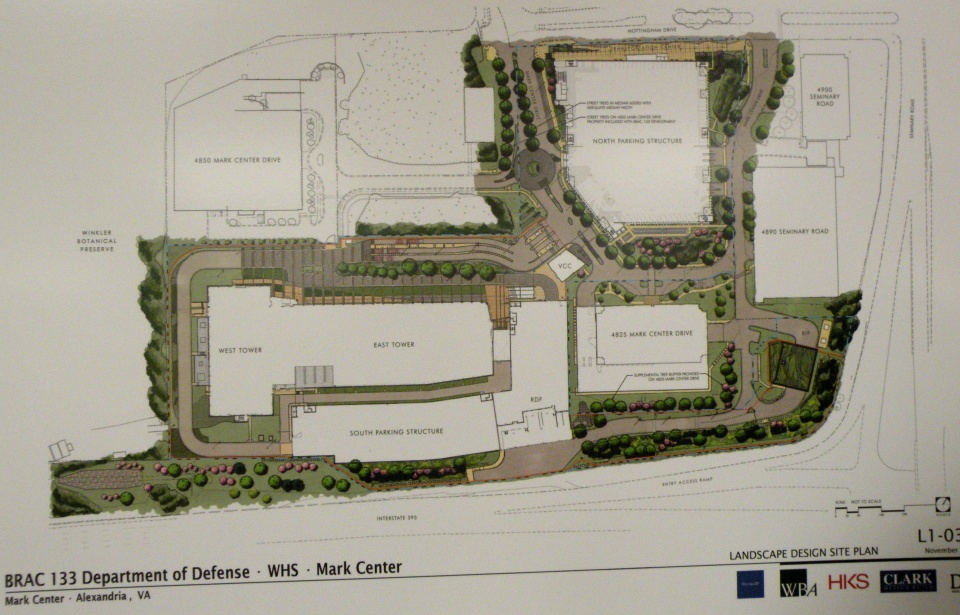
Another board showing the basic design and street improvements for Mark Center Road:
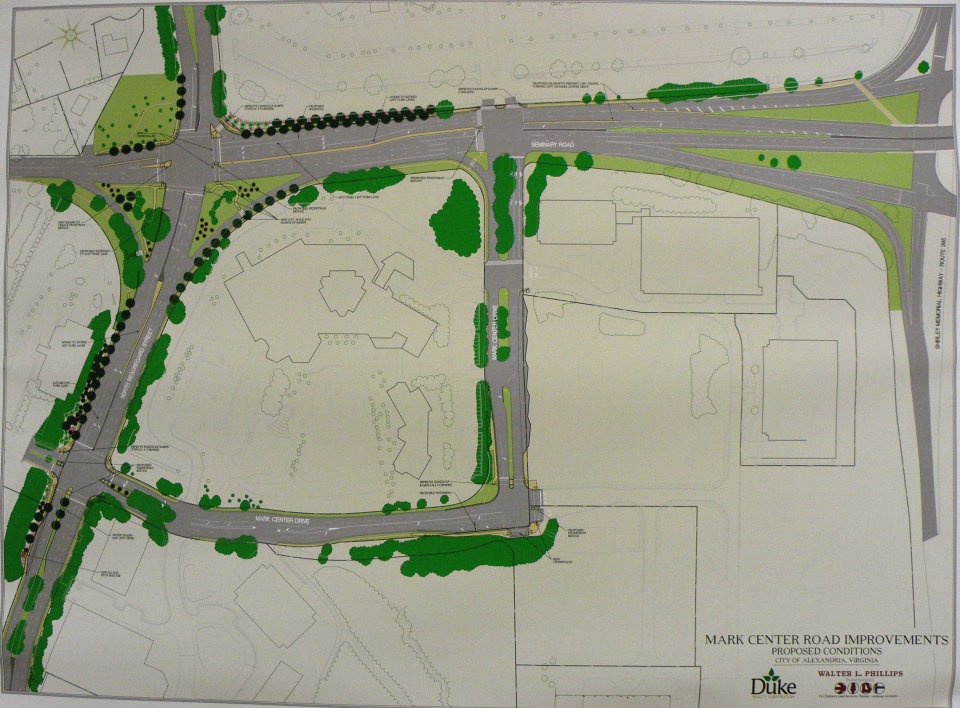
But the bulk of the meeting was focused on the two alternatives that VDOT studied in depth and brought forward, A1 and D. With boards showing how they (and the other official alternatives) ranked against each other on the purpose/need and guiding principles:
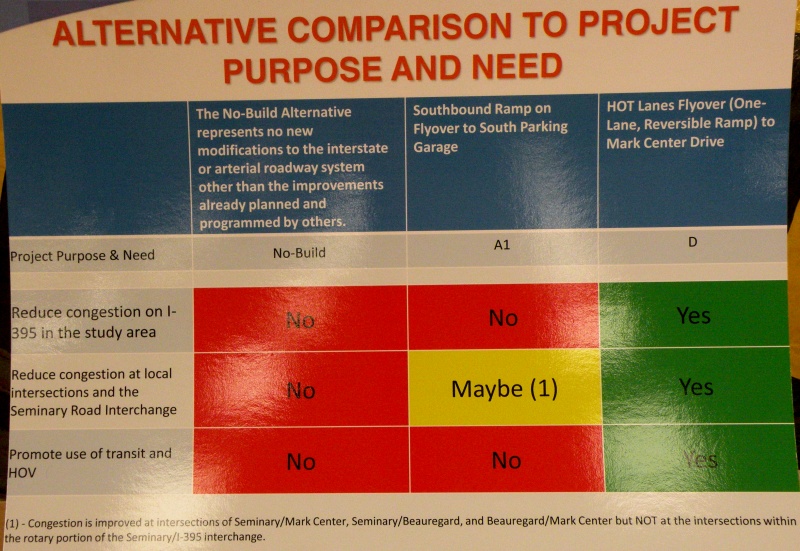
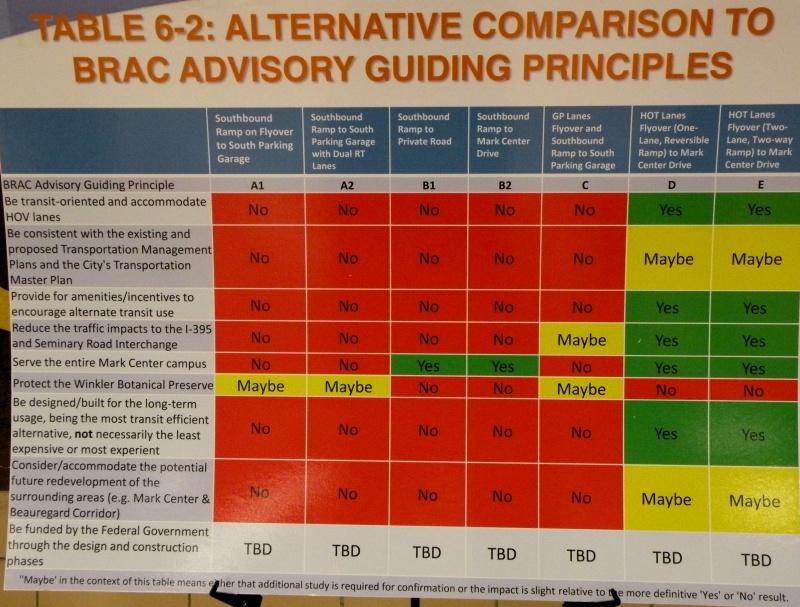
The Alternative layouts themselves are available online.
As you can see, Alt D is a clear "front-runner" amongst the alternatives that VDOT studied. Unfortunately for them, Alt D impacts the Winkler Preserve, and the city is very much opposed to ANY alternatives that would impact the preserve. As I learned at the meeting, even Fairfax County is now rescinding their support of Alt D, likely as a result of the tongue-lashing they received for attempting to convince the city to support that alternative.
So the county is looking (re-looking?) at alternatives for the HOV ramp that don't impact the Preserve, including bringing it into the south access road, directly into the South Parking Garage, or near the South Parking Garage with a bus ramp that loops around to the proposed Transit Center. They're doing this in part because they're very concerned about Mark Center traffic from the south (i.e. from Fairfax County) would otherwise be stuck going through the 395/Seminary Rd interchange, which is already horribly congested.
However, some of the other options are running into roadblocks themselves. The Army apparently isn't thrilled with the idea of the HOV ramp tying into the south access road. City staff are concerned about direct access into the South Parking Garage in no small part because that garage will have only 40% of the overall site parking. According to the county official I spoke with, the Army is at least willing to consider the option with a bus ramp that loops around to the transit center.
This is important because the design for the overall site is for a 40% mode split. Meaning that they're planning the area with the direct intention of having 40% of commuters using a mode other than driving themselves. An impressive attempt, especially when one considers the location isn't on a Metro line.
I spoke with a few people about the idea that promulgated from the March 1 BRAC Advisory Group meeting, with the HOV ramp flying over the interchange to connect directly with Seminary Road North (as I described in an earlier blog post. City staff are very interested in this design. The Fairfax County rep I spoke with expressed some interest. Unfortunately, response from the VDOT consultants was lukewarm at best.
The meeting was more than just discussion...there were a couple impressions that made themselves very evident. First and foremost, both the city and the majority of meeting attenders do not want the Winkler Preserve impacted in any way or fashion. They also want more than just immediate site access to Mark Center...they want a plan that addresses transportation in the general 395/Seminary Rd vicinity.
The final impression I got from the meeting is that VDOT (or at least their consultants) will not look at other alternative proposals unless city officils officially request them, or the proposal "has merit". While there's hope that they'll actually look at some of the other ideas out there or the city will call them out (the latter is a fair possibility), this impression did not leave me with a warm-and-fuzzy. The general impression I got is that VDOT considers this an Alternative D or bust situation.
Time will tell...
March 11, 2010
Oops...
Stupid me forgot about VDOT's public meeting tonight on the I-395/Seminary Rd interchange, and I don't feel like getting (re)dressed to go trapse out to the meeting at this point. Hope somebody from Alexandria made it and could comment on what went on.
So instead, I provided the following online comment to VDOT on the interchange study:
Suggest VDOT look at new options that would provide the benefit of Alternates D and/or E, but that do not impact the Winkler Preserve. One of the options presented at the March 1 BRAC Advisory Group Meeting would be a good alternative to consider: reconfiguring Seminary Rd through the interchange, and providing a direct flyover ramp between the HOV lanes to/from the south and Seminary Rd to/from the west...offering benefits comparable to Alt D but without the impact on the Preserve.
So instead, I provided the following online comment to VDOT on the interchange study:
Suggest VDOT look at new options that would provide the benefit of Alternates D and/or E, but that do not impact the Winkler Preserve. One of the options presented at the March 1 BRAC Advisory Group Meeting would be a good alternative to consider: reconfiguring Seminary Rd through the interchange, and providing a direct flyover ramp between the HOV lanes to/from the south and Seminary Rd to/from the west...offering benefits comparable to Alt D but without the impact on the Preserve.
March 09, 2010
The budget/BRAC bonanza...
Last night's Alexandria Transportation Commission meeting can be summed up in two words: budget, and BRAC.
The budget was the main topic of discussion for most of the meeting, focused on an update from city staff on the city manager's proposed Capital Improvement Program budget for FY 2011 thru FY 2020. In a nutshell, it doesn't look very good. As currently proposed, there is no money for DASH system expansion, the DASH bike racks won't happen until FY 2018, and due to VDOT cutting Urban System funding, very little in the way of street reconstruction outside of already-programmed projects (mainly just the Eisenhower Ave Complete Streets project and the King/Beauregard intersection).
One odd comment is that FY 2011 is the "last year" for CMAQ funds. Which is odd since that is a FHWA funding category, albeit subject to the ongoing debate over the Federal transportation reauthorization. Either way, this ball is in Congress's court.
A clarification on the TIGER grant: previously overlooked by some, there's $670K for capital improvements in the Van Dorn St corridor, previously identified by the city as a priority corridor for improving transit. Also, the $8.5 million for the Potomac Yard transitway, combined with $4 million in previously-secured Federal money, will only build the transitway between Monroe Ave and E. Glebe Rd. It's presumed that south of Monroe Ave (to the Braddock Rd Metro station) will run in mixed traffic, but the city is still searching for the roughly $16 million it will take to get the transitway up to Four Mile Run. One option being discussed is requesting a proffer from the Potomac Yard developer.
Not all hope is lost, however. One of the remaining remnants of the General Assembly's attempts at transportation funding a few years ago (before most of it was struck down in the courts....remember the $2000 speeding tickets for out-of-state drivers?) is an option for the city. Northern Virginia (and Hampton Roads) localities are allowed to levy up to 12.5 cents per $100 of value on non-residential commercial/industrial real estate, which can then be used for transportation purposes.
Some caveats, though. If it's residential property (to include apartment buildings), it cannot be taxed this way. The money MUST be used for transportation, and new transportation capital projects in particular (though operating expenses related to that new capital is also covered), and cannot be used for existing transportation expenses (so the city can't use this levy to substitute for existing DASH funding).
Arlington adopted it at the full 12.5 cents, while Fairfax County adopted it at a 11.5 cent level. Prince William County is apparently considering it.
Though the city hasn't announced what level it will proposed (it must announce a "max rate" by Saturday, though), preliminary indications are that it will propose a 3 cent level. The current proposal would use this money to expand the DASH bus fleet (3 new buses in FY11 and a fourth in FY12), purchase and operate an additional trolley for the King St Trolley service (to reduce headways), install bicycle wayfinding signage, and finally add bike racks to the DASH fleet (instead of waiting until FY18 as the proposed CIP budget does).
The other main topic was BRAC, namely the proposed interchange improvements at Seminary Road to service BRAC-133 at Mark Center. The city received a letter from the Fairfax County Board of Supervisors, who again asked the city to support a modification of Alt D (mostly Alt D with a few elements of Alt E added). Of course, the city is opposed to both Alt D and Alt E due to its impacts on the Winkler Preserve, and the mayor fired off a return letter to the county.
Meanwhile, the BRAC Advisory Group is recommending that BOTH Alt A1 (which the city favors) and Alt D (which Fairfax County favors, as noted above and previously) be dropped, and instead is leaning towards an odd option. A map of it isn't online yet, but here's the option in a nutshell:
- The current Seminary Rd overpass over the interchange would be removed, and Seminary Rd through traffic would go through the interchange. To mitigate this, the revised Seminary Rd would be expanded to allow for 3 through lanes in each direction.
- Replacing that top level would be a new HOV (or HO/T if that ever happens) ramp, connecting between the HOV lanes to/from the south and Seminary Rd to/from the north. This effectively provides the direct HOV lane access to the area without impacting the Winkler Preserve.
- Direct access to/from the BRAC parking garage via the southbound 395 ramp remains as an option.
- Where the revised Seminary Rd meets the I-395 ramps could either remain as the quad-set of signalized intersections that currently exists, or could be replaced by a large traffic circle.
VDOT has also released some new documentation on the interchange proposal, to which city staff feel they "missed the boat" by failing to mention impacts to the Winkler Preserve.
VDOT plans a public meeting on the interchange and their new documentation this Thursday (3/11) at Minnie Howard, while the city is planning another community meeting on April 10th at Landmark Mall.
The budget was the main topic of discussion for most of the meeting, focused on an update from city staff on the city manager's proposed Capital Improvement Program budget for FY 2011 thru FY 2020. In a nutshell, it doesn't look very good. As currently proposed, there is no money for DASH system expansion, the DASH bike racks won't happen until FY 2018, and due to VDOT cutting Urban System funding, very little in the way of street reconstruction outside of already-programmed projects (mainly just the Eisenhower Ave Complete Streets project and the King/Beauregard intersection).
One odd comment is that FY 2011 is the "last year" for CMAQ funds. Which is odd since that is a FHWA funding category, albeit subject to the ongoing debate over the Federal transportation reauthorization. Either way, this ball is in Congress's court.
A clarification on the TIGER grant: previously overlooked by some, there's $670K for capital improvements in the Van Dorn St corridor, previously identified by the city as a priority corridor for improving transit. Also, the $8.5 million for the Potomac Yard transitway, combined with $4 million in previously-secured Federal money, will only build the transitway between Monroe Ave and E. Glebe Rd. It's presumed that south of Monroe Ave (to the Braddock Rd Metro station) will run in mixed traffic, but the city is still searching for the roughly $16 million it will take to get the transitway up to Four Mile Run. One option being discussed is requesting a proffer from the Potomac Yard developer.
Not all hope is lost, however. One of the remaining remnants of the General Assembly's attempts at transportation funding a few years ago (before most of it was struck down in the courts....remember the $2000 speeding tickets for out-of-state drivers?) is an option for the city. Northern Virginia (and Hampton Roads) localities are allowed to levy up to 12.5 cents per $100 of value on non-residential commercial/industrial real estate, which can then be used for transportation purposes.
Some caveats, though. If it's residential property (to include apartment buildings), it cannot be taxed this way. The money MUST be used for transportation, and new transportation capital projects in particular (though operating expenses related to that new capital is also covered), and cannot be used for existing transportation expenses (so the city can't use this levy to substitute for existing DASH funding).
Arlington adopted it at the full 12.5 cents, while Fairfax County adopted it at a 11.5 cent level. Prince William County is apparently considering it.
Though the city hasn't announced what level it will proposed (it must announce a "max rate" by Saturday, though), preliminary indications are that it will propose a 3 cent level. The current proposal would use this money to expand the DASH bus fleet (3 new buses in FY11 and a fourth in FY12), purchase and operate an additional trolley for the King St Trolley service (to reduce headways), install bicycle wayfinding signage, and finally add bike racks to the DASH fleet (instead of waiting until FY18 as the proposed CIP budget does).
The other main topic was BRAC, namely the proposed interchange improvements at Seminary Road to service BRAC-133 at Mark Center. The city received a letter from the Fairfax County Board of Supervisors, who again asked the city to support a modification of Alt D (mostly Alt D with a few elements of Alt E added). Of course, the city is opposed to both Alt D and Alt E due to its impacts on the Winkler Preserve, and the mayor fired off a return letter to the county.
Meanwhile, the BRAC Advisory Group is recommending that BOTH Alt A1 (which the city favors) and Alt D (which Fairfax County favors, as noted above and previously) be dropped, and instead is leaning towards an odd option. A map of it isn't online yet, but here's the option in a nutshell:
- The current Seminary Rd overpass over the interchange would be removed, and Seminary Rd through traffic would go through the interchange. To mitigate this, the revised Seminary Rd would be expanded to allow for 3 through lanes in each direction.
- Replacing that top level would be a new HOV (or HO/T if that ever happens) ramp, connecting between the HOV lanes to/from the south and Seminary Rd to/from the north. This effectively provides the direct HOV lane access to the area without impacting the Winkler Preserve.
- Direct access to/from the BRAC parking garage via the southbound 395 ramp remains as an option.
- Where the revised Seminary Rd meets the I-395 ramps could either remain as the quad-set of signalized intersections that currently exists, or could be replaced by a large traffic circle.
VDOT has also released some new documentation on the interchange proposal, to which city staff feel they "missed the boat" by failing to mention impacts to the Winkler Preserve.
VDOT plans a public meeting on the interchange and their new documentation this Thursday (3/11) at Minnie Howard, while the city is planning another community meeting on April 10th at Landmark Mall.
Subscribe to:
Posts (Atom)