July 28, 2012

More Tales From The Sand

The ship is coming to collect me today, so this may be it until the next port visit. It's been a fascinating, if hot and dusty, time here in Djibouti. Plenty of stuff on base to occupy one's time if they know where to look.

That said, it's still hot. It hit 112F yesterday. That's the temp, not the heat index. The heat index was much higher. Even though it's the desert, we're close to the water so there's still some humidity. No, I didn't try to fry an egg, cause there's no blacktop to fry an egg on.

And it's dusty too. Especially today. Wind kicked up early this morning off the desert so there's this hazy dusty pall over the sky today. And dust everywhere. Someone who's an OCD cleaner would have a heart attack in this place.

Forgot to mention before that there's NO overhead wires here. Everything electrical is underground. Since everyone's walking everywhere, it helps, but it's got a bit of an urbanist ring to it.

That's all from Djibouti. Our next installment will come whenever and wherever the powers that be allow it. Gotta love workin for the man every night and day...

July 27, 2012

A Sad State of Bollards

A couple months ago, cyclists along the Mount Vernon Trail in Alexandria noticed something disturbing beginning to happen. VDOT was starting to install bollards along the trail in the vicinity of the Wilson Bridge. First reported by Rootchopper (a regular bike commuter along the trail), these bollards have also been discussed on WashCycle and WABA.

And it's a mess. Besides being hard concrete (making them painful to run into), they considerably narrow the trail lanes, making it difficult to pass through at a normal rate of speed and VERY difficult for bikes hauling a trailer (i.e. a child trailer) or wide wheelchairs to pass through.


Bollards galore.

The bollards in this photo are at the bottom of the hill as one follows the MVT down from the Washington St Bridge Deck. With the downhill grade, cyclists are approaching these bollards at a higher-than-normal rate of speed, making it difficult to slow down and all but guaranteeing significant injury if they were to hit them. Furthermore, there is a curbed area of rocks just beyond the bollards on the left, an additional hazard in this area.

Who installed these and why was at one point a good question. At first it was hard to get clear information on who was responsible. NPS first said VDOT, since it's part of the Wilson Bridge project. Then VDOT said it was NPS, since Jones Point Park is under their jurisdiction. This tug of war lasted until WashCycle regular TurbineBlade (coincidentally a former neighbor of mine) received a letter from VDOT confirming that they were responsible for installation. The letter noted that because the bridge is considered "Critical Infrastructure", additional measures to prevent a terrorist attack were mandated by TSA/Homeland Security. The bike trail bollards are part of those additional measures. That it's VDOT's responsibility was also confirmed in a tweet to me by NPS.

This hasn't sat well with bicyclists and cycling advocates. A meeting at the site was coordinated recently between WABA, the Alexandria Bicycle Pedestrian Advisory Committee, VDOT, and Federal officials, discussed in WABA's blog post linked above. Officials acknowledged the bicycle safety concerns of the bollards but insisted that the bollards must remain and it's too late to make major changes. Instead, VDOT's response to the meeting was to add the plastic bollards on either side, additional striping through the bollards, and the warning signs that are still too close to the bollards:


VDOT's "solution".

While the threat of terrorists doing something to the bridge is understandable, the response from Federal and state officials is very excessive compared to the safety concerns the bollards and curbed rock area present to everyday users. In short, officials are sacrificing everyday safety to guard against what is really a very unlikely threat. If Homeland Security and VDOT insist on keeping the bollards, what they need to do is widen the space between bollards so there's less risk of bicyclists crashing into them. The rock curb area also needs to be reduced in size, something that VDOT has agreed to consider.


Second set of bollards on the MVT, north of the Wilson Bridge.


A third set of bollards exists on the connection to Royal St.

I have a full photo set from my "trip to the bollards" on Flickr. All the photos I used in this article are from that photo set.

July 26, 2012

Tales From The Sand

In the grand tradition of Tales From The Sharrows, it is my honor to bring you this unofficial subsidiary post. Perhaps it's the heat getting to me, or something about all this dust and sand, but here it is.

Nominally, this is a US Navy "Expeditionary Base", but there are so many other people from all the services, plus lots of contractors, that you really can't call it just a Navy base. Yeah, it's near the water, but not ON the water. It is, however, near the airport...so close you can smell the helicopters taking off and landing.

Security is pretty lengthy to get into base, as one can expect given this part of the world, not to mention that Somalia (in all its lawless glory) is almost within spitting distance. But once you're on base, you have just about everything you need here. Mess hall, showers, gym, coffee shop (open 24/7 at that). And an Exchange if you need to buy toiletries because the airline lost one of your bags (since recovered, but not until after spending $33 on "essentials").

There's even a suburb....Cluville. Dunno if that's because of all the clues to where people live here, or some super-secret Certified Likeness Unit project, but Cluville has a laundry shop, a mini-mart, and the MWR Internet center. It's also probably the only suburb in the world where you can get DC-style population density with a FAR less than 0.5.


BTW, it's dusty here. Photo by US Army Africa.

The living units aren't too bad. On the outside, they look like cargo containers, but inside there's enough room for 2 beds (or if you're an unlucky low-ranking junior sailor/soldier/airman/marine, 3 beds), adequate air conditioning, and some lights and lockers.

It's also one of the few places in the world where you'll see more pavement for pedestrians than you will for vehicles. Virtually every road/driving space on base is gravel. And we have 2 bus routes: the Blue Route and the Red Route. They look to be 15-20 passenger "mini-buses", but if you like vehicles it's your best chance for a ride since there are almost no private cars on base.

This being the desert, it's pretty dry. Except last night. It rained. A whole half-inch. But it was enough to turn dust into mud that lasted into this morning. I heard this was only the 3rd time it's rained this year.


It sorta looked like this. Photo by Flickr user strukanb.

It was also a brief respite from the 108F temperature we had yesterday. Think we only hit 107F today...it's a cooldown!

Signing off. Here for another day or so before I catch a ship to go bust some pirates. I wonder if it's dusty out there too?


Did I mention it's dusty here? U.S. Air Force photo.

A thought on bus shoulder lanes...

Last week, BeyondDC had a short piece on the potential for expanded bus shoulder use in the DC area. The area's Transportation Planning Board is asking for a working group to study the concept.

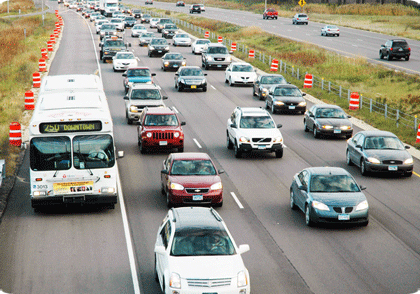
I'm sure BDC is aware of this, so I'm surprised he didn't mention it, but the Twin Cities metro area has a very extensive system of bus-allowed shoulders, where buses can use the shoulder during times of congested traffic. This is supported by state law, which governs the use and speed limits of bus shoulder use (namely a 35 MPH speed limit, but still faster than traffic going 10-15). MnDOT has been very supportive, and has undergone a program of shoulder improvements and minor shoulder widening to better handle the buses using the pavement. This improvement program isn't just for the freeways...several at-grade arterials have had their shoulders improved for bus use. These improvements helped out what was already a successful express bus system in the Twin Cities metro...the I-35W South (i.e. south of downtown Minneapolis) express buses alone carry 15,000 passengers a day.

Bus using the shoulder during heavy traffic. Image from Metro Transit.

MnDOT has also recently started implementing what they call a "Dynamic Shoulder Lane" on I-35W. They got the idea for the concept from VDOT and what they do on I-66. In their test case (which got UPA money a few years back from the Feds), the inside shoulder on northbound I-35W near downtown was reconstructed and upgraded...during normal times, it's basically a shoulder. During peak hours, it's basically a HO/T lane. Buses and HOVs can use for free, and solo drivers can pay to use if they have a transponder.

Unfortunately, most of the congested freeway segments in the DC area lack an inside shoulder, so similar application in DC may be limited. However, if VDOT can find a way to fully reconstruct I-66 between Fair Oaks and the Beltway (as they should've done 20 years ago), they could limit the major reconstruction to that segment and convert the wide inside shoulder west of Fair Oaks into a dynamic HOV or HO/T lane. This would allow for not just 1 but 2 HOV (or HO/T) lanes on I-66 in the peak direction between the Beltway and Gainesville (assuming the Fair Oaks-Beltway reconstruction allowed for 2 HOV lanes). The potential issue here would be enforcement, since I-66's HOV lanes are already heavily violated. But at the same time, MnDOT found that HOV violations on their I-394 and I-35W lanes dropped in half when they converted the lanes to HO/T lanes.

It's a concept that the DC area would do well to consider and implement.

June 17, 2012

An Eastern Shore ride

Since I'm about to get underway for awhile, I took advantage of the very awesome (albeit windy) weather yesterday to head up to the Eastern Shore for some biking. I'd noticed on my transfer down that there's a new bike trail near the southern tip of the shore. Indeed, last year the US Fish and Wildlife Service built a 2.5 mile bike/hike trail from their Eastern Shore National Wildlife Refuge north along the old Cape Charles Railroad. It's the start of what some hope to be a longer path connecting to Cheriton, although the farmers along the route are not happy about it.

From the Wildlife Refuge Visitor Center (just off SR 600 near US 13), I followed the trail north to its end at Cedar Grove Dr (SR 645), then hopped over to Seaside Rd (SR 600) and up to Sunnyside Rd (SR 639) and over to the hamlet of Oyster, VA where I found a local beekeeper selling honey.

From Oyster, it was a straight shot back on Sunnyside Rd to the town of Cheriton. I only briefly brushed Cheriton before I moseyed my way back to Seaside Rd and back south to the Refuge and my car.

All in all, it was just under 28 miles with beautiful weather but a bit of wind, especially heading north.

Photos from the day are on my Flickr page.

June 13, 2012

#BikeNorfolk Begins

I've just finished my first week back in Norfolk. I was able to get out on the bike 5 out of the 7 days (technically 6 if you include spending Saturday in DC), and thus officially begin what I'm calling #BikeNorfolk. I'll be using that hashtag on Twitter to record my bike travels in the city. Hopefully others will pick up on it.

I will admit, after a 7 year hiatus, I was impressed with the level of bicycling I've seen so far, especially in and around the Navy Base, Ghent, and the Freemason District. And it's not just those biking for training/exercise. Many folks, including women (I'd guess 35% of the total) and families with children are hitting the bike for small, local trips. This is all the more impressive because Norfolk has an acute lack of bicycle infrastructure. Individual, isolated sections of bike lane exist here and there, but they're very scattered and there is no connectivity between them.

There's also a small, but obviously growing, number of sailors who are using bikes to get around the Norfolk Navy Base. I was down by one of the ship piers yesterday and the one bike rack next to the pier gate was absolutely overflowing with bicycles (a few were "double-parked"). The lack of available rack space led several to lock their bikes up to a fence across the street.

Early on, I timed some of my trips to see how long it'd take me to get to various locations nearby. A sampling of those:

- Harris Teeter: 8 minutes
- Farm Fresh (a local supermarket chain): 11 minutes
- An awesome gelato shop that just opened in Ghent: 10 minutes
- A good DC friend who also transferred down to Norfolk and lives in Ghent: 9 minutes
- MacArthur Center, a shopping mall that some credit with saving downtown Norfolk: 4 minutes
- Freemason Abbey, an awesome restaurant downtown located in a converted church: 2 minutes (almost takes longer to lock the bike up).

With where I'm at and the relative proximity to many shops, it's often quicker to bike than to drive and attempt to park. While my complex has its own parking garage (only shared with the YMCA next door), it takes approximately 5 minutes for me to walk across the street, get up to my car (residents have to park on the upper floors...the lower floors are reserved for the YMCA), and drive down and out of the garage. Conversely, I can be out on the street with my bike in less than 30 seconds. That's a 4+ minute advantage to the bike over the car.

Unfortunately, I have not been able to bike commute yet. I made the attempt yesterday, only to realize that I can't fit what I need to bring into my backpack. I'll either have to pre-stage a uniform at the office, or acquire some panners and/or a trunk bag to go on the back rack. The plan is to do so once I'm back from a short sea trip next month.

With Norfolk's Harborfest/OpSail 2012 celebration that went on this past weekend, it was the perfect opportunity for a short bike trip around the waterside. You never know what you'll come across, whether it be other bikes...


Penny Farthing, anyone?

Or other sailors...


Manning the watch

Or even other ships.


The "new" Age of Sail

Sometimes you meet other people...


Musicians on the Green

And sometimes you just want to sit and play.


Making beautiful music

Lastly, does anyone know what an all-red bike signifies?


Don't think it's a Ghost Bike...

June 07, 2012

A new name, a new place

My long-awaited move to Norfolk has finally come and gone. I packed up what was left of my stuff in the car last week and bid adieu to Huntington and the DC area.


Bye-bye Beltway.

And so "Just Down The Parkway" has become "Just Down The Bay", where I'll continue to chronicle transportation and my bicycling adventures from Norfolk. Speaking of Norfolk, I found a place where The Tide LRT is literally right outside my window:

May 25, 2012

Froggie's #FridayCoffeeClub Finale

As most of you may know, I'm transferring from DC this upcoming week. Wasn't expecting to get a 4-day weekend at first, but my CO granted us today off. So I took advantage of it to hit up my last #FridayCoffeeClub. And yes, this was really my last #FridayCoffeeClub.

For those who don't know, #FridayCoffeeClub is an informal gathering of many of the bike DC crowd at M.E. Swing (a coffee roaster) at 17th and G NW. They meet up for morning coffee every Friday morning. It was initially (and still largely is) organized over Twitter...that's how I heard about it. The main "organizers" are Ed (@dailyrandonneur) and Mary (@gypsybug). Other notable DC bicyclists who regularly stop off are Brian (@SharrowsDC), John (@rootchopper) and Kate (@girlonabikedc). Of course, there are numerous others on Twitter who show up...too many to include here.

A little misty on the ride up, but it was relatively quiet, even on Washington St in Old Town. Noticed bollards at the bottom of the Wilson Bridge for the MVT (more on those later), and of course there are those bicyclists who don't bother stopping for red lights (a particular pet peeve of mine...gives the rest of us a bad name), but all in all a quiet ride up.

Today was perhaps the largest gathering thus far...well over 20 folks stopped by (I lost count). It got to the point where bikes were "double-parked" along the side of the building and even parking across G Street, which led to various comments about adding bike racks or a "bike performance parking district".

Afterwards, after breakfast with a friend, and realizing I forgot my water bottle at Swing (to which I'm grateful to Brian for handing it to the barista for me to retrieve), I rode down to Pentagon via Memorial Bridge and the "path" along Route 27. Though drivers stopped for me at the ramps from GW Pkwy so I could cross, this whole area would still be a lot easier for bikes and drivers if the crossings were grade separated.

The whoe morning was a little bittersweet for me. This is a great group of DC area cyclists, some coming from as far as the Mt. Vernon area, and the coffee's pretty good too. It's definitely something I'm going to miss. Going to an area where bicylcing is *A LOT* less prevalent is going to be a challenge.

May 03, 2012

Old Town Bike Parking

Dear Alexandria,

Since you took out the parking meters in Old Town several months ago for the new multispace meters, there are a lot fewer places to lock one's bike up to along King Street. Can you fix this?

Sincerely,

March 26, 2012

Bike commuting while I still can

It's been a busy month. Between college classes, my temporary duty at the Pentagon, and my impending transfer to Norfolk, I haven't had much time for blogging.

But one thing I have been able to do is bike commute, especially over the last two weeks. 7 out of 10 commutes during those two weeks were bike commutes. I was also able to get a few bike commutes in during the previous weeks. And my schedule enabled me to make a few Friday Coffee Club gatherings with the BikeDC crowd.

This week, however, is my last week at the Pentagon. Which means it's my last week for easy bike commuting.

There have definitely been some advantages to the bike commute. First and foremost, it's exercise (all important to the active duty military member). Second, the cost is practically zero...always a plus with gas prices near $4/gallon and a peak-of-the-peak Metrorail fare of $3.05. Commuting time is comparable to the 9A bus (without having to deal with a 30-minute headway) or the off-peak Metrorail commute (my apartment's Metro shuutle doesn't run off-peak). And I was also able to park the bike closer to the office than both the Metro station and car parking.

Between roadtrips and the Suitland commute, I normally average about 2,000 miles a month on my car. Over this past month, though, I've barely put 300 miles on. While the lack of roadtrips accounts for some of that, at least 500 miles of the difference can be attributed to not using the car for commuting.

One thing I've noticed with my bike commuting is an increase in appetite. Unfortunately, instead of holding my food intake steady, I started eating more. So I haven't really lost any weight.

The overall experience is such that, when I transfer to Norfolk in 2 months, I'm going to look for a place to live that gives me the opportunity to bike into the Navy base. Until then, I have 2 more bike commutes to look forward to this week.